The Texas Bill Credit Trap: Why Your 7-Cent Plan Might Really Cost 20 Cents
If you have ever shopped for an electricity plan in Texas, you have seen rates that look too good to be true.
They usually are.
The Headline That Hooks You
Browse any plan comparison site and you will find plans advertising rates under 8 cents per kWh. On paper, that looks like an instant win. But those headline numbers come with a catch that most shoppers never see until the first bill arrives.
Here is a real example. One popular plan advertises 7.4 cents per kWh at 1,000 kWh. Now look at what happens at different usage levels:
| Monthly Usage | Rate (incl. delivery) |
|---|---|
| 500 kWh | 19.9 cents per kWh |
| 1,000 kWh | 7.4 cents per kWh |
| 2,000 kWh | 13.6 cents per kWh |
At 500 kWh, the rate is nearly three times the advertised number. To understand why the rate changes so dramatically, you need to know how bill credits work -- and how providers use them to game comparison rankings.
How Bill Credits Actually Work
The trick is called a "bill credit" -- a flat dollar discount that kicks in only when your usage crosses a specific threshold, usually exactly 1,000 kWh.
Here is why this matters more than most people realize: the credit does not just affect the kilowatt-hours around the threshold. It changes the effective rate on your entire bill.
If your plan has a $129 bill credit at 1,000 kWh, that $129 gets subtracted from your total bill. When you divide your new, lower total by 1,000 kWh, the math produces a beautiful rate -- one that gets the plan ranked at the top of every comparison site.
But if you use 950 kWh? That $129 credit vanishes. Not just for the 50 kilowatt-hours you missed -- for all 950 of them. Your bill jumps by $129 because you fell 50 kWh short of the threshold.
And it works the other way too. Use 2,000 kWh and that same $129 credit gets spread across twice as many kilowatt-hours. The discount per kWh gets cut in half, and your effective rate climbs right back up.
See It in Action: 950 kWh vs. 1,000 kWh
The difference between missing and hitting a bill credit threshold is not a few dollars. It can mean the difference between a $186 bill and a $67 bill -- on the exact same plan.
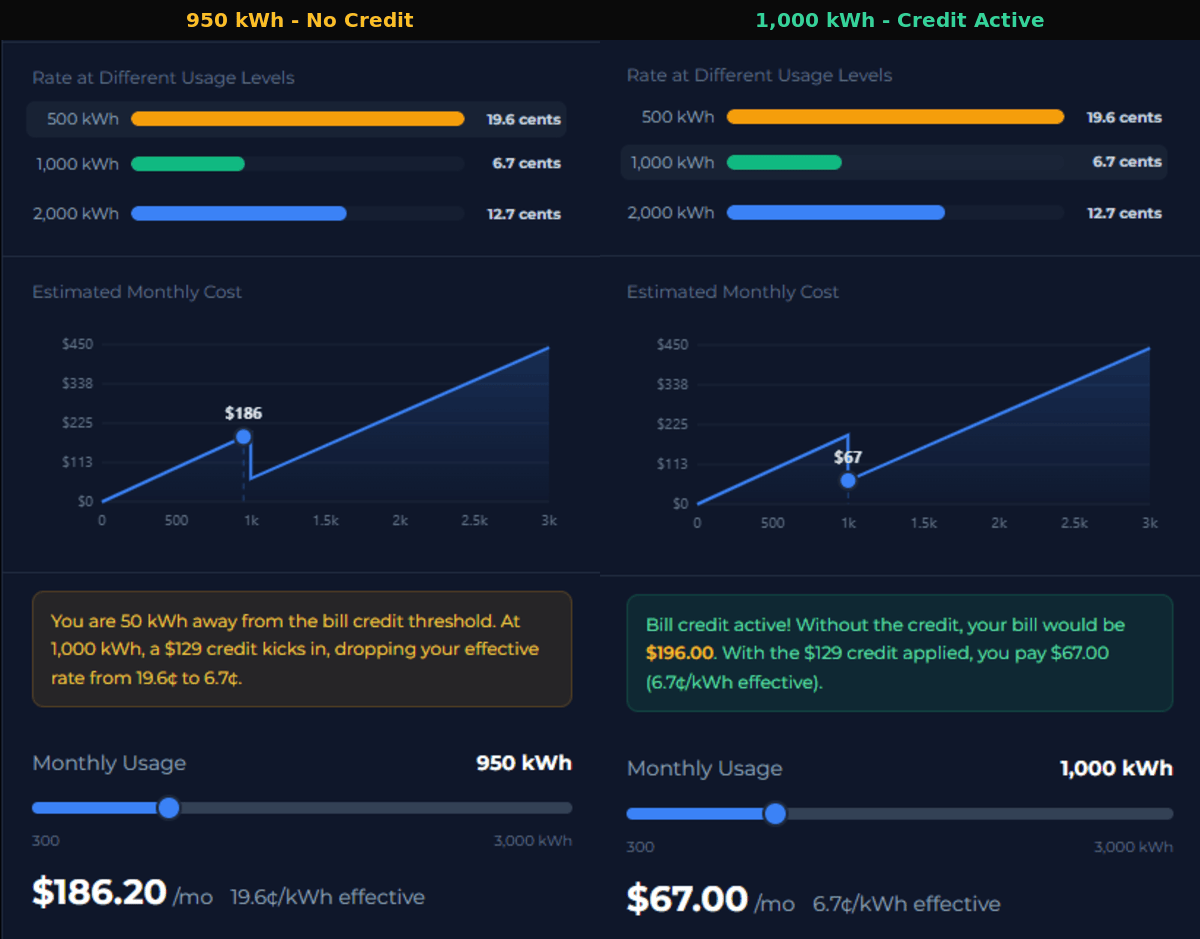
On the left, usage is 950 kWh. The bill credit threshold is 1,000 kWh, so no credit applies. The effective rate is 19.6 cents per kWh and the monthly bill is $186.20.
On the right, usage is 1,000 kWh -- just 50 kWh more. The $129 credit kicks in, dropping the effective rate to 6.7 cents per kWh and the bill to $67.00.
That is a $119 difference caused by 50 kWh of usage. And notice the cost curve chart: the sharp dip at 1,000 kWh is the credit taking effect, followed by a steep climb as usage increases beyond the threshold. The GridWise plan flyout shows this curve for every plan with tiered pricing, so you can see exactly where the cliff sits before you enroll.
The 999 vs. 1,001 Cliff
This is the part that catches people off guard. The difference between using 999 kWh and 1,001 kWh in a month is not 2 kWh worth of electricity -- it can be $50 or more on your bill.
At 999 kWh, you are one kilowatt-hour short. No credit. Full price on every single unit of electricity you used that month.
At 1,001 kWh, the credit kicks in and your entire bill drops. Not just the cost of those last 2 kWh -- the effective rate on all 1,001 of them changes.
That cliff is real, and it hits hardest in spring and fall when Texas homes naturally use less energy. The same plan that saves you money in August could cost you double in October. For a deeper look at how these rate structures work, see the guide to tiered pricing plans.
Why This Exists
Texas Retail Electric Providers (REPs) know that most comparison tools rank plans by the rate at exactly 1,000 kWh. So they engineer plans specifically to score the lowest possible rate at that one benchmark. It is a ranking strategy, not a pricing strategy.
The result is plans that look incredible on a comparison chart but perform very differently in the real world -- where nobody uses exactly 1,000 kWh every single month. Understanding how to read the Electricity Facts Label is the first step toward spotting these structures.
How to Spot a Bill Credit Plan
The telltale sign is a dramatic rate swing between usage levels. If a plan's rate at 500 kWh is double or triple its rate at 1,000 kWh, there is almost certainly a bill credit baked in.
This is exactly the kind of thing GridWise Audit is built to expose. GridWise is a free, independent comparison tool that shows you the rate at 500, 1,000, and 2,000 kWh for every plan -- side by side. No account required and no cost.
Plans with dramatic swings are flagged with a Bill Credit badge so you can see the pricing structure before you commit. You can also compare plans in your specific TDU service area to see local delivery charges alongside the energy rate.
While browsing, star any plan to save it to your favorites. Then visit the GridWise homepage and use the Favorites filter to compare your saved plans side by side.
How WattTrim Calculates Around the Trap
Most comparison tools -- including PowerToChoose -- show you a single rate at 1,000 kWh and call it a day. That is exactly how bill credit plans game the system.
WattTrim takes a completely different approach. When you take a photo of your electricity bill with WattTrim photo capture or upload a bill photo or PDF, we do not just check the 1,000 kWh benchmark. We calculate your cost on a curve using your actual monthly usage for every month in your history.
Here is why that matters: if your home uses 800 kWh in March and 1,600 kWh in August, a bill credit plan behaves completely differently in each month. In March, you miss the credit threshold and pay full price. In August, the credit kicks in but gets diluted across higher usage.
WattTrim runs this calculation month by month across your real consumption pattern using your Smart Meter data, then adds it all up. The result is your true annual cost on each plan -- not a snapshot at one artificial benchmark.
That is how a plan advertising 7.4 cents per kWh might actually cost you 14 cents or more when your real usage pattern hits the math. And it is how WattTrim finds the plan that genuinely saves you money across all twelve months -- not just the one that looks best on a comparison chart. For more on this process, see how WattTrim's audit works.
Is a Bill Credit Plan Right for You?
Bill credit plans are not necessarily bad -- if your usage consistently lands near the credit threshold, they can actually save you money. The problem is when you do not know the credit exists, or when your usage varies month to month (as it does for most Texas households between summer and winter).
The only way to know for sure is to test the plan against your actual usage across all twelve months. That is exactly what a WattTrim audit does. Take a photo of your bill or upload a bill PDF, and WattTrim calculates your real cost on every available plan -- including bill credit plans and free nights and weekends plans -- month by month. If a bill credit plan genuinely saves you money at your usage pattern, WattTrim will surface it. If it costs you more in the months you miss the threshold, you will see that too. The same analysis applies to time-of-use plans: WattTrim uses your actual day-versus-night usage split to determine whether a nights and weekends plan would lower your annual cost or end up costing more during peak hours.
Your Smart Meter records usage in 15-minute intervals, giving you a far more accurate picture than a single monthly average. That granularity reveals whether a bill credit plan is genuinely a good fit or a trap waiting to spring.
For a broader look at finding the right plan beyond just bill credits, read how to find the best electricity plan in Texas. And to see how electricity brokers compare with PowerToChoose, check out our guide on the differences.
See How Much You Could Save
Upload a photo of your electricity bill and get personalized results within minutes.
Trim My BillAlways Free