
Electricity Plan Cost at Your Real Usage, Not the 1,000 kWh Average
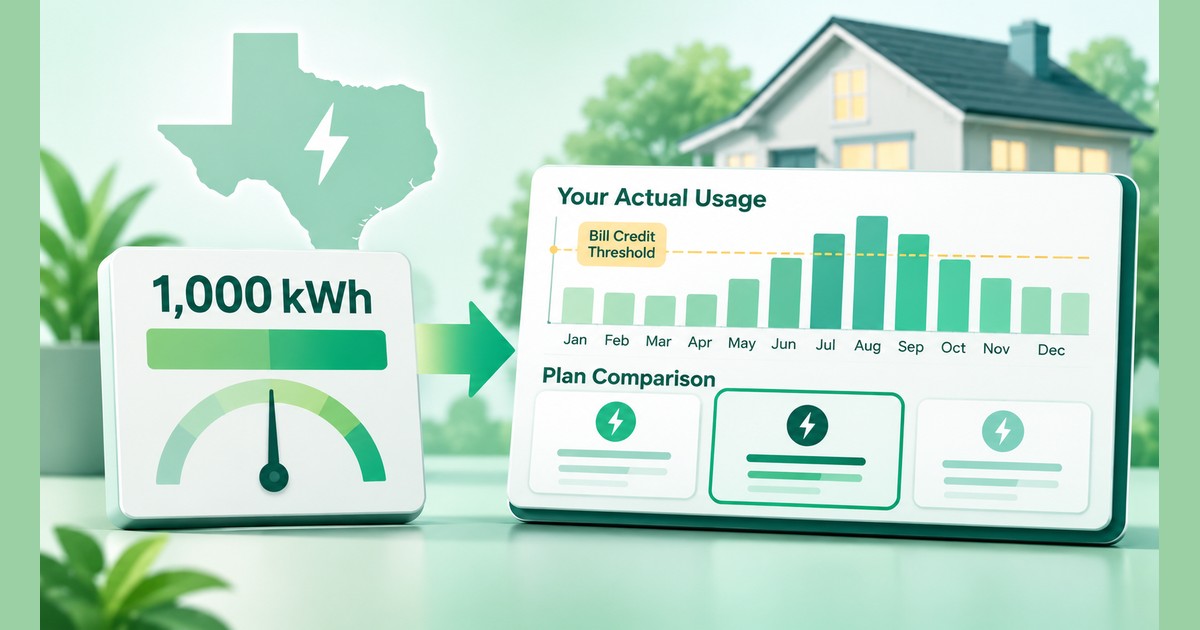
The price per kWh on a Texas fact label is calculated at three sample usage levels: 500, 1,000, and 2,000 kWh a month. Your home almost never uses exactly one of those amounts, and it uses very different amounts in July and in March. Pricing plans at your real monthly usage is the most reliable way to see which plan costs less for you.
For the full checklist on choosing a plan, read how to choose a power plan in Texas on GridWise Audit. This article takes one step from that guide and goes further: replacing the 1,000 kWh average with your own numbers.
Why the 1,000 kWh Price Can Mislead
The 1,000 kWh price is a useful way to line up labels side by side. It is not a prediction of your bill.
Some plans are built to look best at exactly that level. A bill credit that kicks in at 1,000 kWh can make the advertised price look low, but in a month when you use 950 kWh the credit disappears and the real cost per kWh jumps. Base charges work the other way: a fixed monthly fee looks small at 2,000 kWh and much larger in a low-usage month.
Your usage moves around all year. A typical Texas home can use several times more power in a hot summer month than in a mild spring month. A plan that is cheap in one of those months can be expensive in the other.
Where Your Real Usage Comes From
If you have a smart meter, your usage history is stored with Smart Meter Texas. It shows how much power you used over time, including the months that drive most of your annual cost. The guide above explains how to get it. Twelve months of data captures a full set of seasons.
How the Free Audit Uses Your Usage
The free WattTrim audit takes your Smart Meter Texas data and your current energy rate, then:
- Prices plans in your area at your actual monthly usage, month by month, instead of at a single sample level.
- Accounts for bill credits by checking whether each month's usage reaches the credit level, using the plan facts we have on file.
- Shows your effective rate today, worked out from your own interval data.
- Shows a month-by-month table of your usage and the estimated cost on the top plan.
- Still shows the advertised 500, 1,000, and 2,000 kWh prices for each plan, so you can compare them with what the plan would cost you.
When a plan detail, such as the base charge, is not confirmed in our records, the audit marks it as unconfirmed instead of guessing.
How to Read the Difference
Compare a plan's advertised 1,000 kWh price with its estimated cost on your usage. If the two tell different stories, trust the one built from your usage. Then look at your highest and lowest months in the monthly table. A plan that only wins in one season may not be the best choice for the full year.
Before you enroll, confirm every number on the plan's Electricity Facts Label.
When Your Usage Changes
Your usage changes when you add an electric vehicle, install solar, change your thermostat habits, or move. A one-time audit reflects the past year. WattTrim Sentinel, a subscription at $4.99 a month or $44.99 a year, pulls fresh Smart Meter data every week and compares it with available plans, so your recommendations update as your usage changes. Sentinel also sends a monthly report and alerts when a better plan appears or your contract is nearing its end date. These ongoing features are not part of the free audit.
See How Much You Could Save
Upload a photo of your electricity bill and get personalized results within minutes.
Trim My BillAlways Free